

And today we talked with the amazing Evelyn Valancourt. You know, an entire universe lives inside her. Evelyn Valancourt is a character from an old Gothic novel transformed into a modern heroine with inner demons, rebellion, and grace. In this interview, you won’t find those same old conversations about producers and likes. Instead, there’s the scrape of bare skin, crypts with wax and mold, the creative challenge of pandemic isolation, collaboration with a Japanese drummer and a London sound producer, and the search for a new sound through a string quintet. Get ready to discover more about Evelyn Valancourt and her music, written in blood, smoke, and true defiance.
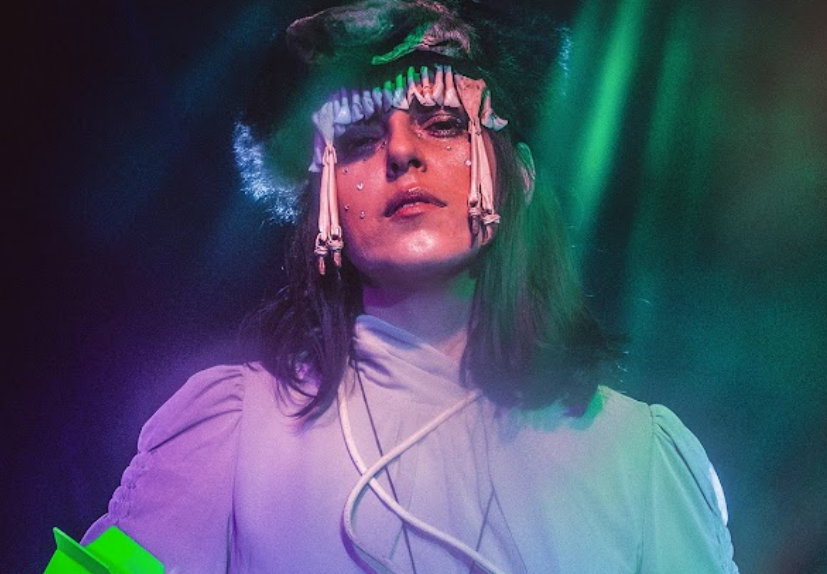
Hello Evelyn, I’m so delighted to speak with you and thank you for finding the time—I know you’re incredibly busy. I’ll be honest, when I first heard the name of your project, I got goosebumps. Evelyn Valancourt—that’s a character from the 18th-century Gothic novel “The Mysteries of Udolpho.” There she was such a fragile heroine who wandered through gloomy castles and experienced all sorts of mystical things. And you took that name and transformed it into a modern dark rock project. If your Evelyn Valancourt met the original novel’s heroine in some parallel world—what would they chat about over a cup of tea?
The name Evelyn Valancourt is not only a tribute to the Gothic novel: it is a concentration of decadent romanticism and elegant decay, the kind of thing that seduces you by making eyes at you while putting its hands around your neck. It represents the darkest and most fragile part of each of us, but also the most fascinating. Evelyn is a woman and she is not a victim: she is a character who seems to have come out of an Oscar Wilde story or a Guillermo del Toro film, with more blood and much less sugar. Our music it’s a bit like reading her secret diary.
If our Evelyn met the original Valancourt, it would be anything but tea and biscuits. They would meet in a crypt that smells of wax and mold, with a recording studio hidden behind a secret door. The two would look each other in the eye, and instead of small talk, they would talk about personal ghosts, the grieves they’ve had to face, and how to resist the world without becoming John Wick-style killing machines. Not Hollywood heroism, but the desperate courage of those who just want to take their freedom, whatever it takes.
2020-2021—when I think back to that time… oh dear… it was complete chaos for all musicians. Everyone was stuck at home, concerts were cancelled, studios were closing. And yet during this period you managed to record an EP with a Japanese drummer from BABYMETAL, Steve Vai’s sound engineer, and a London producer. How on earth did you find these people and convince them to work with a new project?
It was a surreal period: locked in our homes, the world collapsing around us, and us barricaded inside wondering if it was the beginning of a zombie epidemic or just an Orwellian conspiracy. In Italy, it was total chaos, but the truth is that we’re pretty nerdy, and being locked up with our obsessions didn’t feel like punishment. On the contrary, we had ideas burning in our heads, and finally we had all the time we needed to let them explode.
We came out of our previous recording project with broken bones, no label, no contracts. This time, we just wanted to do things our way. No producers telling you that you’re “too light for these” or “too heavy for those.” Evelyn Valancourt was born as an act of insubordination: total freedom, without compromise. Human relationships did the rest.
In those months, the web was the only possible teleportation device. Thanks to it, you could find yourself playing sitting on your bed and at the same time be in a studio on the other side of the planet.
Enrico Sesselego is a long-time friend as well as a super professional sound engineer. He worked for many years with Steve Vai in his Los Angeles studio, followed Paul Gilbert on tour, and worked on many international productions. He has that old-school approach to recording that fascinates us and manages to put you at ease during sessions. He introduced us to Yuya Maeta, a Japanese drummer with one foot in rock and the other firmly planted in progressive metal, while he was playing with BABYMETAL. A cyborg of precision who loves Josh Freese, capable of transforming our tracks into something more alive. Sure, it would have been epic to lock ourselves in the studio together, but remotely it turned out to be just as creatively delirious.
For the mixing, however, we decided to let go of the wheel and trust Chris Coulter, a London-based producer (Idles, Arcane Roots). We wanted the tracks to travel, to absorb a different color as they passed from hand to hand. When you do all the stages by yourself, you risk going crazy and losing sight of the big picture. He, on the other hand, found the key to our first chapter, tailoring a sound for us that sounds like the true birth of Evelyn Valancourt.
And yes, it’s a concept, and this is the first chapter. The protagonist is seeking emancipation, against a backdrop of war and misery. Our story is set a century ago. Yet that déjà vu, that feeling of always living through the same disaster disguised as something “new,” sounds damn familiar today.
I absolutely loved how you describe Evelyn Valancourt: “a figure embodying the darkest part of each of us,” but with aristocratic elegance. This duality is simply mesmerising. When you create music under Evelyn’s name, do you feel you’re addressing precisely this dark side in people?
Every piece we write is a chapter in the story of Evelyn Valancourt: a woman seeking redemption, perhaps without even realizing it, and doing so by throwing her contradictions in your face. Evelyn is the mask that allows us to look without filters at the part of ourselves that we normally try to sweep under the rug: fragility, anger, obsession, fears. Feelings that seem not to be allowed if you want to be accepted. Just to not let you stand out from the crowd and being yourself instead of a number. Otherwise you’ll be judged without mercy. But she doesn’t whine, she doesn’t play the victim. She does it with a certain elegance, smoking in your face while telling you her worst secrets.
When we write, we don’t try to sugarcoat anything. We’re interested in digging into those gray areas that we all have inside. It’s not just therapeutic, it’s an invitation to recognize the dark side without shame. Because the dark side is alive and beautiful even of we try to deny it, and often it’s the only part that doesn’t lie.
The problem is that our society is afraid of this stuff. You can’t be sad, you can’t say your life sucks, you have to BE POSITIVE always and in any case, your life coach orders you to. So chase your goals, wink at the target, monitor your performance, and gorge yourself on numbers, likes, and shares that mean nothing. Well, Evelyn says fuck all that because Mr. Hyde is much more honest than Dr. Jekyll.
Your concept album tells the story of a young woman from the early 20th century seeking emancipation between war and poverty. I picture a girl in a long dress and corset, secretly reading forbidden literature. And she even smokes cigarettes in dark alleyways! If your heroine found herself in 2024, what would surprise her most about modern women’s lives? And conversely—what could contemporary women learn from her?
Evelyn Valancourt’s story is about a life infected by misery: hunger, shame, social violence. Misery is a common denominator between her era and ours, the only difference being that misery used to be more honest and sincere. At the beginning of the 20th century, you could recognize it immediately by dirty hands, patched clothes, and empty stomachs. Today, misery is glossy, photoshopped, and cleaned up. AI then puts the finishing touches on it, as on social media, where we sell the best version of ourselves and call it success.
If Evelyn arrived in 2025, she would be fascinated by how many women have taken control of their own lives, not caring about their roles as angels of the hearth or emotional crutches for fragile men. This achievement would be the first thing that would strike her. But it wouldn’t take her long to realize that certain ghosts from her century have never been exorcised. Because yes, women today can run companies, go into politics, write forbidden novels without being burned alive… but just say the word “feminism” and it immediately becomes a label, an insult. Here’s what today’s women could learn from Evelyn: not to have to ask anyone’s permission and keep going on burning down social bias to subvert the order of things.
You’re from Sardinia—that beautiful island in the Mediterranean where there are probably stunning sunsets and ancient energy. Yet your music sounds so cosmopolitan—Japanese drums, London production, Gothic English literature. It’s like pizza with sushi—shouldn’t work in theory, but turns out unexpectedly delicious. How do your Sardinian roots influence dark rock?
Sardinia is a living paradox. On the one hand, you have archaic rituals and wild nature that still make you feel connected to something primordial; on the other, you have isolation that risks turning into a prison. It is a womb that protects you, yes, but it can also crush you if you don’t look beyond the horizon.
Our relationship with this island is complicated and cracked. Yet, it persists. We carry that ancient energy within us, but at the same time we are not postcard types, nothing like “sun, sea, and spritz.” In fact, perhaps it is precisely the fact of living in a dream location that pushes us to seek out the dark side, to reject the aesthetics of a tourist village and to construct an imaginary world that goes elsewhere. Our influences all come from outside Italy. From the 1990s, from alternative rock, from Marilyn Manson, A Perfect Circle, Rammstein, Smashing Pumpkins, to the modern drifts of Bring Me The Horizon and Architects. We can’t say exactly how Sardinian roots filter into all this, but perhaps it is precisely our visceral hatred of the Mediterranean cliché that fuels our dark sound. We prefer the shadows at the sunlight on the beach.
Let’s talk about the main thing! The EP “To the End of Drama”came out in 2021, and I know you’re actively working on new material—recording three tracks with a string quintet from the National Academy of Santa Cecilia and again with Japanese drummer Yuya Maeta. The release is planned for late 2025. What’s actually happening with the project right now? These three new songs—are they dramatically different from the EP or do they continue the same story? And the most important question—when will we finally hear the complete 13-track concept album in its entirety?
We have a lot of material and have completed pre-production of the entire concept. We’re not nostalgic, even though we’d like to be, but releasing all the songs all at once today is counterproductive. Releasing thirteen tracks in one go is perceived like launching an encyclopedia on TikTok, a suicide mission. The music business says so, the algorithms say so, the people who (don’t) listen voraciously and scroll on to the next piece of content say so. It’s a paradox: we live in an age of overabundance and no one is hungry anymore. Yet, we’re keeping on desire something more we didn’t even know existed. Once upon a time, bands would disappear quietly for years, and the anticipation would grow like a secret cult fueled by fanzines and rumors. Today, if you don’t release something, you don’t exist. So we’re needed as jukeboxes or entertainment monkeys. We don’t like this. We do not claim to be like Tool, who release an album every eclipse, but neither the serial producers that Spotify would like us to be.
So we decided to take our time and respect the breath of music. The three tracks we’re mixing now are another piece of the Evelyn Valancourt puzzle. Still with Enrico in the recording studio, Yuya on drums, and this time a string quintet from the Santa Cecilia Conservatory in Rome to take us straight into the abyss in our Sunday best. The coordinates remain the same, but there is an evolution. The direction is darker, more monolithic, with walls of sound colliding with moments of extreme fragility. The first extract, “Get Movin,” will arrive by the end of 2025.

Tell me, how do these sessions go? Do you have to explain to classical musicians what “dark atmosphere” means, or do they intuitively feel this aesthetic?
We worked closely with Virgilioof at strings arrangements, a soundtrack composer whose taste would be blasphemous to describe as “mainstream.” His solutions are refined, often disturbing, with that touch of dissonance that immediately reminds you that you’re not in a Broadway musical.
We didn’t want the strings to be elegant wallpaper; we wanted them to be the real protagonists, even at the cost of shadowing guitars and bass. And the musicians understood us right away: no long explanations like “this is the dark atmosphere”; they got into it naturally, bringing their own experience and sensitivity. We are thrilled with the result! You can have the most expensive digital libraries in the world, but the human touch, with all its imperfections and scars, still remains unbeatable. And who knows, maybe one day we’ll even release some raw versions, just vocals and strings: beauty and anguish distilled without anesthesia.
Are you ever haunted by the thought that somewhere there are people listening to your songs and creating their own versions of what happened to the heroine next? And if so—would you ever want to hear these alternative stories?
We would love to hear these alternative versions. The thought that there is someone out there listening to the songs and creating their own mental sequel to Evelyn’s story makes us proudly smile. After all, that’s how music works. You throw out a monster and every listener dresses it up with their own nightmares, their own wounds, their own fantasies.
And perhaps that’s the beauty of living in this schizophrenic age. You can connect, share, and transform one story into a thousand others. The dogma of the artist pontificating from the top of their Olympus no longer exists; today, the audience is a co-author, and if Evelyn ends up being reborn a thousand times in the minds of others… so much the better. That is precisely her destiny.
You know, there are artists who create music for a season, and there are those who create something eternal. Your project is clearly about the latter. The themes you explore through the image of an early 20th-century woman—the struggle for freedom, searching for oneself, inner demons—they’re relevant across all eras. What message would Evelyn Valancourt send across the centuries?
Thank you for your words. It’s nice to know that we’re not just filling the air with noise, but that something more is coming. The image of the early 20th-century woman is a pretext for us, an elegant disguise behind which to hide the real mess: the lack of freedom, the demons that knock at night, the desperate need to understand who we really are. Evelyn is the echo of all those battles that seem to belong to the past, but which in reality punctuate our lives even today. And let’s not forget that the historical period we are entering is increasingly dark and dominated by violence.
Evelyn’s message is that there will always be a war within us, and that the century doesn’t matter. You can be in 1793, 1917, or 2025, but the barbed wire that surrounds you is the same. There is no self-help manual recipe, only the stubbornness to resist and the desire to tear away the chains with your fingernails. And if that doesn’t work, maybe yes, this really is a ghost story, and we are nothing more than unwitting mediums playing for her.
All musicians have some strange habits or superstitions. Some can’t sing without their favourite coffee mug, others put on lucky socks before recording, and some must listen to the same song before going on stage. Do you have any strange rituals or superstitions connected to music?
We have our little routines, but nothing too dramatic. We wouldn’t even call them superstitions, more like a sort of “decompression before impact.” Some of us sink into silence before a concert or studio session. No music, no chatter, no distractions. Others bring all kinds of comfort food, candy, herbal teas, coffee, and sweets into the recording studio. They sit on the highest stool available and enter a state of concentration worthy of a Tibetan monk under the icy water of a waterfall. And when they are about to go on stage, they already feel free and don’t need anything else. And then there are those who never stop warming up and, like an athlete at the Mustafar Olympics, enter a trance-like state, in perfect symbiosis with their instrument. But there is one thing we do every time we are about to step onto a stage. We hug each other tightly. No words, no motivational speeches, no tribal cries. Just silence and the sound of our breathing. It’s like a reset, we throw out our anxieties, we turn off the voice of the world and make room for our alter ego, the darker and hungrier one called Evelyn Valancourt. She is the one who then takes the stage and we become her means. And when the chaos starts, then we are no longer alone, she is there screaming, whispering and fighting alongside us.




 SoundVille ~ Music reviews, Interviews and Podcast .V.