

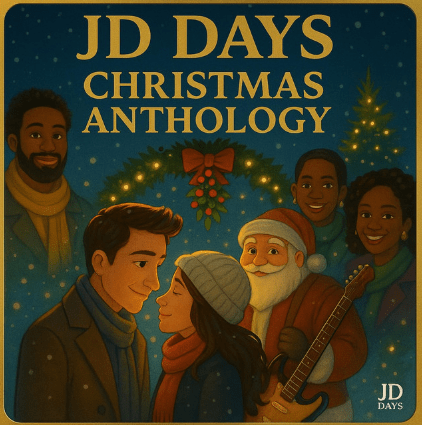
Dear listeners and readers of Soundville, the holiday season often brings reflection, memory, renewal, and sacred music that carries meaning across time. In our conversation with JD Days, we explored how the songs from the album JD Days Christmas Anthology reinterpret the spirit of Christmas through sound and narrative.

JD Days are a UK-based creative collective blending pop-rock, folk, and cinematic visual storytelling. In this interview, they spoke about reinventing Santa for a louder world, discovering connection through instrumental music, and expressing intimacy through small, quiet moments. What started as a collection of songs grew into the cinematic story JD Days Christmas Anthology, exploring belief, attention, and a renewed way of seeing Christmas.
“Here Comes Santa” – What does your Santa look like?
I loved the idea of Santa keeping his soul but updating his energy. Visually, he’s still recognisable — the red, the warmth, the generosity — but he exists in a world that feels louder and more alive. In the video, Santa doesn’t arrive quietly with sleigh bells; he arrives with momentum. Electric guitars felt like the right metaphor for modern belief — that feeling of excitement when something joyful cuts through the noise. It’s still Santa, just tuned to a different frequency.
The bridge videos — planned or discovered?
They were discovered rather than designed. The songs came first, but once I began to place them next to each other, I realised they were asking for breath — moments to reflect, to transition, to let emotion settle. The bridge pieces emerged organically during that process. In a way, they helped me understand the anthology itself. They’re not fillers; they’re connective tissue — small emotional chapters that give the whole story coherence.
Research and animated worlds — did you travel to snowy New York?
Not physically, no — but emotionally and visually, absolutely. Research for me meant observation: films, photographs, memories, sounds. Snowy New York exists in our collective imagination as much as it does geographically. I wanted to capture the feeling of being there — the loneliness, the romance, the sense of scale — rather than documentary accuracy. Animation allows you to distil reality into something truer than literal realism.
Did you write songs for specific holiday moments?
Yes — but I also wanted to leave space. Some songs naturally leaned toward certain moments: quiet nights, long drives, reflective hours. Others are more communal — songs for rooms full of people. But I didn’t want to prescribe usage too tightly. Christmas is personal. The same song can mean different things to different people, and that openness felt important.
Why an instrumental “Evergreen Christmas”?
Removing lyrics changes the centre of gravity of a song. Suddenly, the listener brings their own story instead of following mine. With Evergreen Christmas, the melody and harmony carried enough emotional weight to stand alone. Details in the arrangement — small movements, textures — become more visible without the vocal leading the way. It felt like the right piece to close the project quietly, almost like end credits.
“Angel Woman” — how did you show the angelic?
I deliberately avoided literal wings or halos. The angelic quality in that song is about presence rather than spectacle — calm, grace, reassurance. Visually, it’s shown through light, movement, and stillness. Sometimes the most angelic thing is simply someone being there when you need them. I wanted that sense of quiet strength rather than fantasy imagery.
A perfect film moment for these songs?
Evergreen Christmas belongs to a reflective montage — someone walking alone at night, city lights blurred by snow, memories flickering in and out.
All You Need Is Love is the opposite: a final scene where everyone converges — not perfectly, but honestly. It’s the song you play when the story resolves not because everything is fixed, but because connection remains.
Covers — reinterpret or preserve?
Both. A cover has to honour memory while offering perspective. With Happy Xmas (War Is Over) and All You Need Is Love, I wanted people to recognise the emotional DNA immediately — but then feel that it was being spoken in a new voice. You don’t replace a classic; you have a conversation with it.
The narrator — why that voice?
The narrator needed warmth without sentimentality. Authority without distance. I wanted a voice that felt like someone guiding you gently, not instructing you. We listened to several options, but when we heard this voice, it was immediate. Narration shapes how a story breathes — and this one allowed the anthology to feel cohesive rather than episodic.
The biggest surprise?
How emotional some of the animation became. There were moments where visuals unlocked something in the music that I hadn’t fully felt before. When you work at this scale, you expect technical challenges — but the real surprise was emotional. The project ended up being more intimate than I planned, and that’s something I’m grateful for.





 SoundVille ~ Music reviews, Interviews and Podcast .V.