“People rarely remember how professionally your spreadsheet was organised,” the Zombie Fest organisers says. “They remember how the event made them feel.” After more than twenty years of promoting events, they have earned the right to treat spreadsheets with mild contempt, even while relying on several terrifyingly detailed ones to place 96 artists across six stages.
Their answers reveal people who still enjoy the unruly parts of a rave: the timetable abandoned after one set, the room discovered by accident, the costume that seemed wiser at home and the record capable of erasing a twenty-year age gap within seconds. They also speak with the caution of organisers preparing the largest music event ever hosted by Cambridge Junction, fully aware that scale can alter the personality of an event long before the audience notices.
Zombie Fest 9 takes place on October 31, with N-Trance, Grooverider, Stanton Warriors, Ultrabeat, Slipmatt, Jaguar Skills, Mr C and dozens more on the bill. Before the doors open, we spoke with the organisers about protecting the festival’s identity, programming across generations and the decisions already shaping ZF-X.
How much chaos are you willing to leave inside Zombie Fest before tightening the organisation begins to kill the atmosphere people bought tickets to experience?
Quite a lot, actually. A rave should never feel completely controlled. If everything is too polished, too timed and too predictable, you start removing the energy that made people fall in love with event in the first place. Behind the scenes, though, it has to be the opposite. Security, production, artist movements, timings, welfare and safety all need to be incredibly organised so that the audience can experience something that feels spontaneous. That’s the balance.
If you removed every famous name from the poster, what would still make somebody recognise the event as Zombie Fest within the first half hour of arriving?
The mixture of music, atmosphere, the people and the Halloween theme.
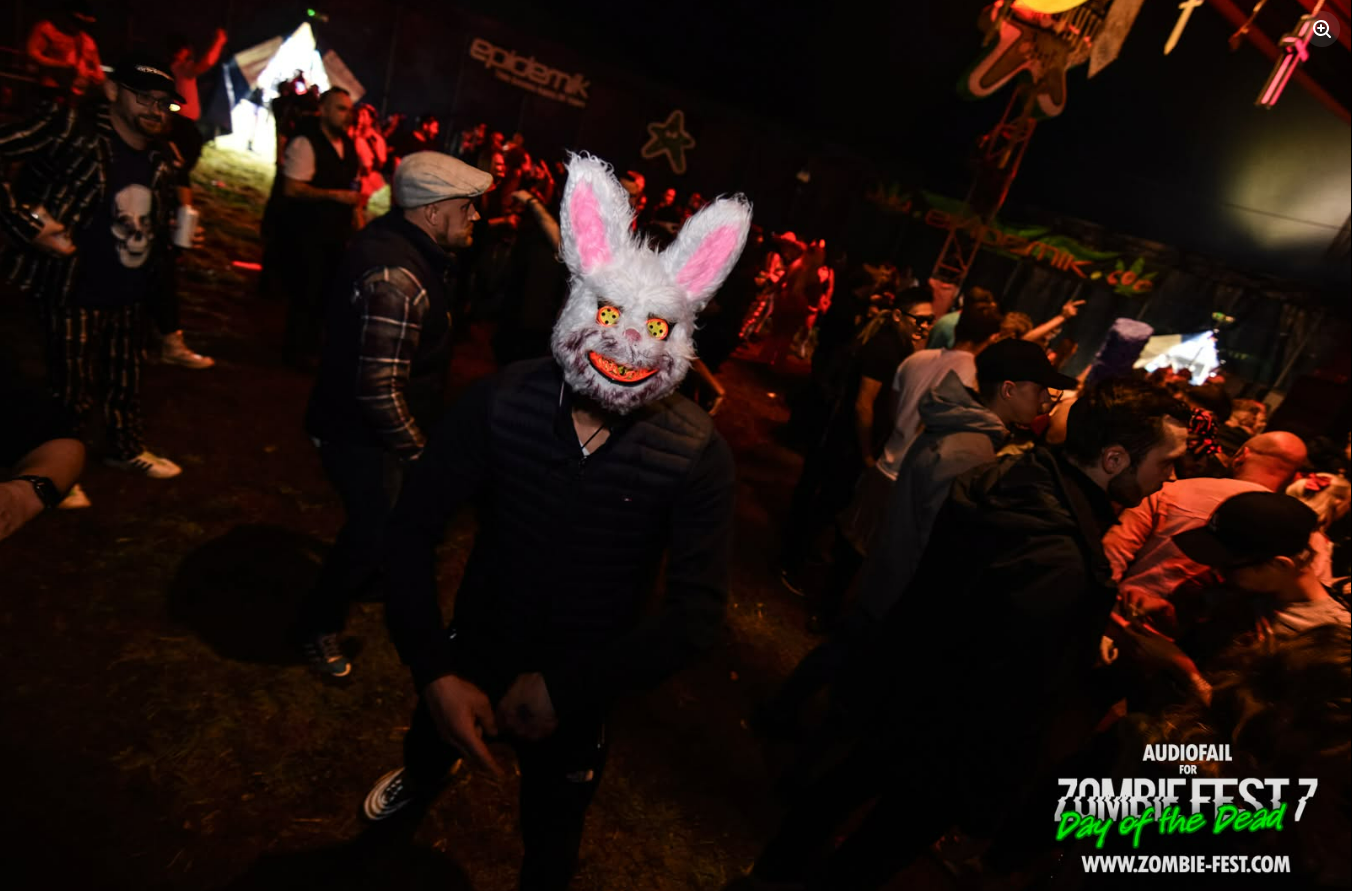
Zombie Fest has never been one genre and it’s never just been a list of headline DJs. You can walk through the venue and hear completely different generations and genres of dance music within a few minutes. You’ve got people dressed up, characters appearing around the venue, different rooms with their own identities and this slightly chaotic atmosphere running through all of it. There’s also a friendliness to the crowd that I think is important.
Which booking on this year’s line-up required the longest argument among the organisers, and what was the disagreement really about?
I wouldn’t say there was one huge argument, our stage promoters are very hands on in the booking of their line-ups which best represent their sounds. We run through shortlists and some wild card ideas. We also get many requests from artists wanting to play so it’s a good position to be in.
Zombie Fest has always tried to pull something different out of the bag, and I actually think it’s healthy when underground and club talent gets a mainstream platform and then comes back into its natural environment.
If every booking was completely predictable, the festival would become predictable too.
How do you stop nostalgia from controlling the night when many people will arrive wanting the music to return them to a particular club, friendship or period of their lives?
You don’t fight nostalgia because it’s incredibly powerful. Those memories are one of the reasons people come. A record can take somebody back twenty-five years in about three seconds, and there’s something brilliant about watching that happen. The danger is when nostalgia becomes the entire purpose of the event. We don’t want Zombie Fest to feel like everybody is looking backwards all night. That’s why we mix generations of artists, different styles and different approaches. Some sets will give people exactly the record they came hoping to hear, while somewhere else somebody might discover something completely new. Zombie Fest has always supported new talent like Pulsar and DJ Archie, nostalgic acts like N-Trance and Mr C and to international megastars like Chase & Status and Paul Oakenfold while still being a platform for local talent.
What usually tells you that a crowd has stopped behaving as several separate generations and finally become one room?
You can see it. At the start of an event, people naturally arrive in their own groups. The older ravers are together, younger crowds are together, people follow particular DJs or genres. Then somewhere during the day that starts disappearing. Usually there’s a record or a set where everybody reacts at exactly the same time. You look across the room and suddenly nobody cares who first heard the track in 1998 and who discovered it last month on social media. They’re all singing the same hook or waiting for the same drop. That’s the moment it becomes one crowd, and from a promoter’s point of view, that’s one of the best things you can see.
If two sets that you personally want to watch are scheduled at the same time, do you treat that clash as a programming failure or proof that the line-up has enough depth?
Definitely proof of depth. With six stages, clashes are unavoidable. If we produced a timetable where everybody could comfortably watch every artist they wanted to see, then we probably hadn’t booked enough good artists.
The frustrating thing is that I suffer from it as well. There will be DJs on the bill that I’ve personally booked because I really want to hear them, and I’ll probably be dealing with something backstage or standing in another room when they play. That’s the same with any festival, but you make choices, and sometimes the set everybody talks about afterwards is the one you hadn’t even planned to watch.
Which artist on the bill could completely wrong-foot an audience that thinks it already knows what kind of set they are going to hear?
Grooverider and Slipmatt would be good examples. A lot of people immediately associate one with drum & bass and jungle, and one with house but at Zombie Fest they are going back to their roots – Grooverider is playing a house set and Slipmatt a 90s Hardcore set. That’s exactly the sort of thing I like. You have artists with decades of history and credibility who can suddenly show an audience another side of their musical knowledge. People sometimes forget that many of the DJs who became famous within one genre grew up buying records across all sorts of styles. So somebody might walk into that room expecting one thing and get something completely different. Those are often the sets people remember.
What have you learned about the difference between selling a large number of tickets and creating an event people still talk about six months later?
Selling tickets gets people through the door. What happens after they walk through it determines whether you’ve actually built anything. You can have a huge line-up and sell thousands of tickets, but if the experience feels anonymous then people consume the event and move on.
The events people talk about months or years later normally have moments they couldn’t completely predict. A surprise set. A ridiculous costume. Meeting somebody. Finding a room they weren’t expecting. Hearing a record at exactly the right moment. You can’t manufacture every one of those experiences.
What you can do is create an environment where they’re likely to happen. That’s probably the biggest lesson from promoting events for more than twenty years: people rarely remember how professionally your spreadsheet was organised. They remember how the event made them feel.
How far can Zombie Fest grow before its size begins working against the closeness, unpredictability and slight sense of danger that gave the event its identity?
That’s something I think about quite a lot. Bigger isn’t automatically better. There’s obviously an ambition to keep growing Zombie Fest, but I never want it to become one enormous stage with everybody staring in the same direction. The ability to disappear into different rooms is part of its personality, the event is an overall experience.
You should be able to leave one atmosphere, walk thirty seconds and find yourself somewhere completely different. That unpredictability gets harder to preserve as an event becomes larger. So future growth probably isn’t simply about capacity. It might mean better environments, stronger production, more creative spaces and better experiences rather than endlessly adding people. The moment Zombie Fest starts feeling like a generic large festival is probably the moment we’ve grown it in the wrong direction.
If ZF-X becomes the tenth edition, which decision are you currently avoiding because making it would force you to admit what the festival needs to become next?
Probably deciding how much of the old Zombie Fest we’re prepared to leave behind. That’s the uncomfortable part. When something works, the safest thing is to keep repeating it with slightly bigger artists, slightly bigger production and another number on the artwork. But if we’re calling the tenth edition ZF-X, then it has to justify the name. That means questioning things we’ve done for years simply because they’ve always been part of Zombie Fest.
The music and the multi-room DNA will remain, but visually and creatively I think we need to be braver. At some point you have to stop asking, “How do we make Zombie Fest bigger?” and start asking, “What should Zombie Fest become?”
I probably know the answer already. I’m just not quite ready to give all of it away yet 😉 but keep an eye on the website www.zombie-fest.com