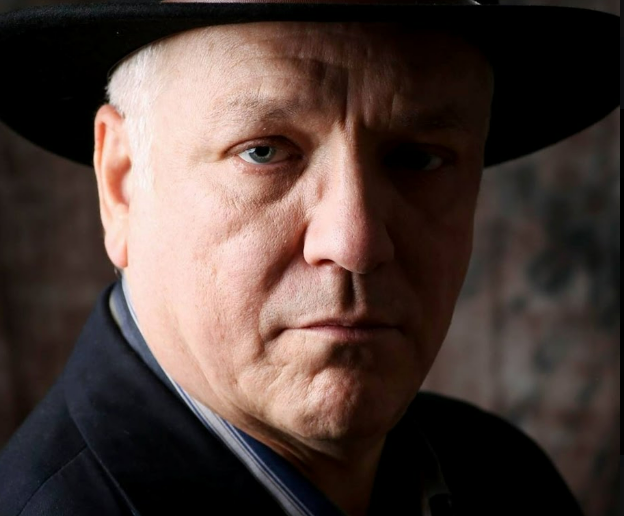

Pete Cater is a British jazz drummer and bandleader. He’s the kind of musician the mainstream press ignores and television never calls — which is precisely why he deserves your attention. Growing up in Staffordshire in a household where jazz played before he could walk, Pete spent his twenties on cruise ships, holiday camps and provincial pantomimes before arriving in London at twenty-nine with no connections, no label backing and no music college pedigree. What he had instead was two decades of hard-won experience, a sharp eye for character and an unshakeable belief in the music he wanted to make.
Now sixty-three, he leads his own big band and collects four- and five-star reviews in Jazzwise. His latest release is a sweeping big band EP built around a West Side Story arrangement originally written by Florian Ross for the Scottish National Jazz Orchestra, donated to Pete by Stephen Duffy and Tommy Smith so he could record and perform it live. Part of it was tracked at Abbey Road. Part of it in a school hall in Middlesex. We sat down with Pete to talk about music, money, age, geography and what it actually takes to build a world-class career well away from the spotlight.

Pete, hello! Thank you for taking the time! You recorded the West Side Story EP in a school hall during the summer break. An empty building, silent corridors, desks pushed against the walls — and in the middle of all that, jazz comes to life. Most musicians at your level gravitate toward studios with history, with a name on the door, with a half-million-pound console. You chose a school. Did the acoustics of the hall work the way you expected, or did the sound you ended up with surprise even you?
One of the tracks on the EP was recorded in a school hall in Middlesex, the other one was recorded in Abbey Road. There’s really no discernible difference in quality between the two, and Chris my engineer, who pointed me at the school in the first place, says it has acoustic qualities equal to any top London studio. With so many circumstances of this kind it’s all about having the right people around you, with the right skill set and a thorough understanding of what we are all trying to achieve.
You could move into a top studio for weeks and waste all kinds of money if you don’t have the right musicians and the right people in the control room. The music I produce is entirely self-financed. I’m not getting money from a record label, or for that matter, taxpayer sponsored arts funding.
When you are spending your own money you tend to be a little more circumspect where budgeting is concerned, and if a day recording in a school hall with fabulous acoustics saves me two and a half grand as opposed to using a top studio I’m going to make that saving.
I can, and do produce a world class big band album for under twenty grand, that’s nothing when you look at the budgets for a lot of recording. A small combo of maybe four or five musicians I can record in about five hours and issue a finished product, including top quality design and manufacture for under five grand, often significantly under five grand. And they get four and five star reviews in Jazzwise magazine so I must be doing something right.
Your father played drums semi-professionally. That means jazz was filling your house before you could walk. There are people who grow up inside music and at some point want to escape it — do anything at all, as long as it’s their own thing. You, on the other hand, sat down behind a kit as a teenager and never got up. At what specific moment in your childhood did you realise the drums were yours?
I was behind the drums way before my teens. The home environment was full of music. Toy drums, a little ‘bits and pieces’ set that my Dad had for practice, records, books, magazines, and the radio. It was perfect for osmosis and the signs were there from very early on. Home move footage exists of me hand drumming on our dustbin lid. I’m sixteen months old and not even walking properly, but the hands were moving. Even though it’s silent film, you can clearly see that my hands are moving rhythmically and in time.
Kids often rebel against their parents’ tastes in music, but the records we heard growing up were so cool that I fell in love with all that jazz and big band music. That said I was a huge fan of what was happening in the world of pop music: the chart rundown on Sunday evening radio was essential listening. When I was about seven my parents bought me a little transistor radio. I would turn it on first thing in the morning for the Radio 1 breakfast show, and late at night would head up to the far end of the dial in search of all manner of new jazz sounds, always introduced in a foreign language. Growing up, my appetite for music was insatiable.

You were twenty-nine when you moved to London. For a musician, that’s a late start in the capital — by that age, many have already built connections, contracts, a reputation in the city. You arrived from Staffordshire, essentially from scratch. What specifically happened in your life at twenty-nine that made you uproot right then?
It wasn’t an overnight decision by any stretch. I first visited London aged six and thought it was magical. Back then it was. These days not so much. Then as now it was the hub of the UK music scene. Whilst there was a bit of a jazz scene round Birmingham, and some very good musicians for that matter, there wasn’t enough to do to sustain a career, and there was no obvious pathway into the upper echelons of British jazz, so having spent my twenties on a nomadic merry go round of cruise ships, holiday camps, summer seasons and provincial panto I had saved enough to put down a deposit on my first home in Elstree, Hertfordshire.
Usually the pathway for young musicians like me was to get into the National Youth Jazz Orchestra and/or a top music colleges. As I was not afforded these opportunities I had to do things my own way. I had received an offer to study in Boston in the early eighties, but without family wealth and before the era of Go Fund Me and the like that wasn’t a realistic possibility.
Being relatively geriatric on arrival in London there weren’t any seats left at the top table. There are lots of great drummers all around my age, and by the end of their twenties they had everything pretty much sewn up. Also they weren’t going to be especially welcoming to a new drummer with talent to spare, hungry for a piece of the pie.
In a way though that was advantageous. The reason being that I was competing for work with other drummers who were trying to get a foothold in the industry, but they were on average between five and ten years younger than me with way less experience, so I was able to leapfrog over them and within six months I was doing all kinds of good quality work as well as having secured a regular gig with the entertainer Val Doonican. He was a great guy who really liked musicians, and that somewhat avuncular warmth that he portrayed on television was not an affectation, it was the man just as he was. Again, not much jazz going on during my first year in London, but a Thursday night residency in the café bar of Willesden Green Library would change all that. I got to meet and play with all kinds of the great and the good of British jazz through that gig, and it led directly to me securing a regular touring gig with singer Elaine Delmar. At exactly the same time I assembled a big band of my own in London. This was early 1995 and the road ahead suddenly became clear and sunlit.
You founded your own record label and through it you release other musicians. That’s a serious responsibility: money, logistics, promotion — everything artists usually run from. You voluntarily took on other people’s careers as well. What was the most painful lesson you learned as a label owner — one you could never have learned from behind the drums?
I don’t think there has been any great pain that I have had to endure so far in a financial sense, for the simple reason that from the outset I made the important decision not to over commit myself with respect to both time and money. Some of the releases have fared better than others, and some have performed better than expected. The records are all extremely high quality in terms of both the performance and production, and they will continue to sell indefinitely as the music contained on them is timeless and not wrapped up in any passing fad or fancy.
Having been in the music industry since the late seventies I have huge amounts of experience of dealing with disappointment. More often than not things don’t work out the way you might have hoped, but it’s important to develop the strength to deal with setbacks, dig deep and keep on battling.
That strength I have built up over the years comes in very handy when you release great products and there’s absolutely no interest whatsoever from mainstream radio. Nothing. It wouldn’t hurt anybody to play one of my tracks just one time, in fact it might do a whole lot of good, and whilst I do retain the disproportionate optimism of a Scotland supporter at the World Cup Finals I am realistic in my understanding of the challenges faced to make any meaningful media impact at all.
The West Side Story release was a huge roll of the dice for me. Whether or not I’ll ever have the chance to record such an epic piece of big band music again is anyone’s guess, it was really a once in a lifetime opportunity. So, pragmatist that I am I decided to go for a two track EP with a shorter, very well-known piece of music that would be extremely radio friendly if handled right. Nothing yet but it’s early days and we are all keeping our fingers crossed.
Success and setbacks can often be mistaken for one another, and more often than not you’ll learn more from what doesn’t go according to plan. That’s why every record I release is done with a different strategy. I’m always looking for new tactics and new angles. Keep the things that work, but don’t be afraid to try something new.
You’re sixty-two, and you speak openly about physical fitness, challenging stereotypes about age. Drums are one of the most physically demanding instruments: endurance, coordination, speed. A twenty-year-old drummer runs on energy and muscle. What does your body give you now that it couldn’t give you at twenty-five?
I’m sixty three actually, and whilst it’s true that there is a certain physical element to drumming, I think it’s fair to say that if one keeps a reasonable degree of physical fitness that ought to be sufficient to be able to handle the demands of most live playing situations. The kind of music I play is all about energy but has very little to do with muscle. One of the great misapprehensions about playing the drums is the importance of muscle memory. Muscle memory gives you something to fall back on, but the real creative highs come when you master the ability to play in the moment. A lot of people who write about musicianship tend to peddle the myth that this super high level of attainment is some special rarefied gift that is only afforded to those blessed with the greatest talent. That’s nonsense. You can learn to play in the moment once you understand the principle involved. It can be taught, and I have taught this skill to a number of drummers who were inquisitive enough to display a genuine interest in really going for the stratosphere in their own playing.

What do you look for in a live performance today that you couldn’t even have imagined in your youth?
With the passing of the years you learn a lot about context, in other words playing what’s right for the music. That could be something extremely simple, a functional rhythmic foundation on which the rest of the music sits, or it could be something extremely sophisticated and advanced. Obviously the latter option is more demanding, and far fewer players will ever be able to achieve that level of attainment.
Sometimes people will try to push a kind of false equivalence between laying down a simple groove and playing a hugely involved piece of work. Our version of West Side Story is far more of a challenge then playing Brown Eyed Girl, but each one has its requirements and needs to be done properly.
West Side Story — the EP’s title references Leonard Bernstein’s legendary musical. That work has already been interpreted hundreds of times, across dozens of genres, on every continent. Choosing material like that means consciously stepping into a very long line. Why did West Side Story become the text through which you wanted to speak in 2026?
I hadn’t recorded my own band in twenty years, for the very simple reason that I hadn’t really got any material I wanted to record. Then this arrangement of West Side Story came to my attention. It was originally written by Florian Ross for the Scottish National Jazz Orchestra in 2017 to mark the centenary of one of my great drum heroes, Buddy Rich. Buddy would almost always end his concerts with a medley from West Side Story, and this new version takes the version that he used to play, adds several more tunes from the original score and pumps it full of steroids. Stephen Duffy and Tommy Smith at the Scottish National Jazz Orchestra displayed extraordinary generosity in donating this score to me so I could record it and perform it live.
For West Side Story you assembled an exceptional lineup of musicians. Over decades in the profession, you’ve played with a vast number of people, and you’ve undoubtedly developed a very precise internal filter — who to invite into the studio and who to leave out. Technique, rhythmic feel, sight-reading ability — those are all measurable things. But there’s something beyond skill that makes you say: “I need this person on the record.” What was the criterion by which you selected musicians specifically for this EP?
That’s simple. It’s a regular, working band. That doesn’t mean that we work regularly I should stress. The opportunities for a band like mine to play live barely make into single figures in any given year. Because the sort of music we specialise in is almost never played on mainstream radio and you certainly won’t see it performed on television we tend to operate in a place that is way beyond the reach of the limelight. But, when we do have an opportunity to play I have a list of first preferences. Many of the guys have been with me for about twenty years now, and I am not just looking for first class musicianship, it has to be the right mix of characters whose personalities blend just as well as their instrumental ability. In all areas of life I consider myself a shrewd and intuitive judge of character, and that is reflected in the people I call for the gigs and recording sessions. On West Side Story one of the guys was unable to make the session as he was recovering from surgery, on Don’t Rain on My Parade you hear all the first call players.
You’ve lived in West Sussex for many years and work from there. The jazz scene is traditionally associated with big cities — London, New York, Chicago. You’ve deliberately built an international-level career from a quiet county in the south of England. How does geography shape the sound — is there something in your music that could only have been born away from the capital?
Hardly anyone in the industry lives in London anymore. Cost is a huge factor as are the working patterns of freelance musicians in this day and age. We have all become commuters with a huge proportion of the workforce living outside the M25. My wife and I left London for West Sussex in 2014 and my career was long established by then. Cleaner air and a slower pace of life are a blessing, and having had serious misgivings at the prospect of moving away from London I have actually ended up being at times busier than in the crazy days of the mid 90s. That said I still consider myself to be ‘London based’ even if I am fifty five minutes by train from Victoria.
What does your ideal morning look like on a day when there’s no gig in the evening and nowhere you need to be?
Oh that’s easy. It starts with tea, lots of tea (Yorkshire Tea) and then I’ll look at the papers to see what kind of a mess the country is in today. I also scour the news looking for possible angles to promote our little corner of the music industry. On weekdays I’ll look at the stock market to see how my investments are faring, share profits pay for quite a few of my musical endeavours. Then I’ll head to the office and spend an hour or two to deal with emails, business enquiries, social media, and my all-important, never-ending quest to try to raise awareness of our little industry niche. Also that time of day is when I set aside time to catch up with any press and media interview requests, and once I have taken care of that it’s time for my daily trip to the gym, where I’m heading now so I’ll see you later.