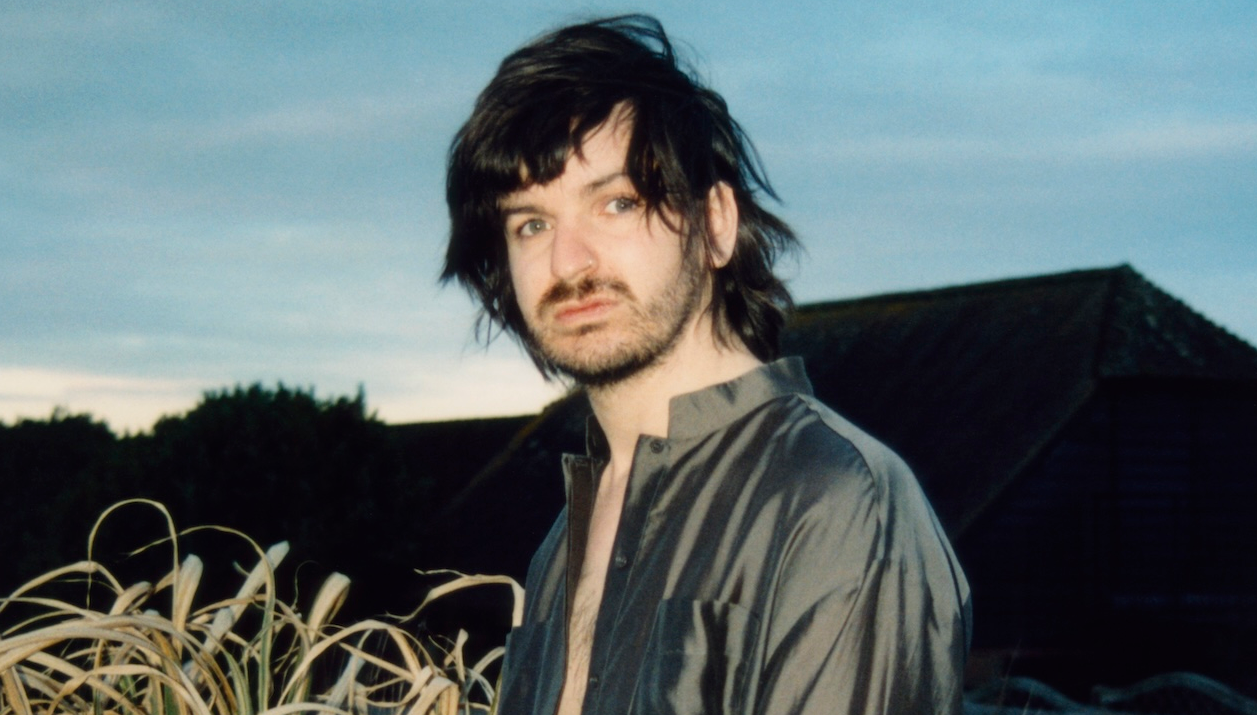
London-based indie-folk songwriter James Crowley grew up studying classical piano, drawn to the scale and emotion of romantic compositions. A guitar gifted for his 18th birthday prompted him to start writing songs and singing his own words. His 2024 release, “Play to Win,” produced by Mike Horner, earned support from BBC Radio 6 Music and opened the door to a writing partnership with Wolf Alice’s Joel Amey.
Crowley calls himself a “song collector,” keeping ideas close until he finds the right company for them. His four-track EP, “Imprint,” released through TRIPEL Records, explores desire, family, past relationships and queer identity, with Amey contributing to the writing and Horner returning as producer. “Co-Pilot,” first played on an acoustic guitar in Amey’s living room, grew into something more expansive once a synth part entered the picture. In our conversation, Crowley discusses those creative exchanges, the decisions behind sharing personal experiences, and his growing interest in recording live and directly to tape.
Hi James, welcome! How did music first become part of your life, and what led you to start writing your own songs?
It’s hard to pinpoint a time before music in my life. I studied classical piano as a child and fell in love with huge romantic compositions but knew that it was never really the way I wanted to express myself. I started writing when I was very generously gifted my first guitar for my 18th birthday – there was something magical about an entirely new way of making sound that really inspired me to actually use my own voice.
“Imprint” follows your 2024 release “Play to Win.” What first set the writing for this EP in motion, and how did you choose the four songs that would make up the record?
I think of myself as a song collector, really. I’m effectively always writing in some form or another, whether that’s scrawling notes on my phone or sitting at the guitar. Imprint, the title track, was actually written around the same time as Play to Win but I knew it needed its own space to breathe. For me, it’s important to think of songs in context. I still definitely hold value in the traditional notion of a body of work, a record. So if a song is telling a story that is out of place with others that I’ve got on the go, I’ll save it for a later date.
You co-wrote “Imprint” with Joel Amey. How did you approach writing together, and could you walk us through how one of the songs developed during those sessions?
Joel! He’s one of the best there is. I first played him Co-Pilot on an acoustic in his living room not really thinking much of it. Later that afternoon we were in his studio making the first demo. His palette is so expansive and we have a really good shorthand in terms of musical taste but we’d never really written together before despite being close pals. What I thought was going to be an intimate little stripped back song ended up becoming something much more ambitious thanks to Joel’s synth part.
What led you to choose “Imprint” as the EP’s title, and how does that word connect to the songs you brought together for this release?
To me, this record is a space for thinking about the marks that are left on us from the relationships and structures around us. We’re all walking around with proof of our experiences but the question is what we choose to do with them.
“Co-Pilot” opens the EP, followed by “Imprint,” “I Wish I Could Just Do Something,” and “(Am I) Strong Enough.” How did you decide on that running order, and what mattered to you when choosing the opening and closing songs?
I knew Co-Pilot had to open the EP, I suppose I wanted to make a dramatic entrance (I’m sure there’s something psychoanalytic buried in that…). And I’m often drawn to the push and pull of big and small moments in a record. So it only felt natural to order the songs in the way that we did.
The songs on “Imprint” address desire, past relationships, family, and queer identity. How did you approach writing about these subjects, and what guided your decisions about which personal details to share?
Admission is a really difficult line to tread as a songwriter. I like to treat my audience as having the intelligence to not need everything explicitly spelled out and spoon-fed. But when there are elements and experiences baked in to the writing that might help someone feel seen or heard, it would be a failure of duty on my part to say nothing.
I know that I didn’t really come into contact with much queer representation in indie music when I was growing up – especially from gay men. So, yeah, I’m a queer man, which means this is a record about queer identity I guess.
7. How do you develop your vocal harmonies? Could you describe how you choose the parts and decide where they belong in an arrangement?
I work in a very instinctive way when it comes to harmony. So sometimes it’ll be a really fast job, and other times there will be a lot of trial and error. If it sounds good, it stays.
8. As a songwriter based in London, how would you describe your relationship with the city? What place does it have in your everyday creative life?
London is both the best and worst place to be an artist. There is always a show or an opening to go to, and I love the fact that it’s really not going anywhere. London will always be London. But it’s also its own microcosm and I think it’s easy to forget that the broader picture is pretty dire: politically, financially, culturally. Gotta love the pub though.
9. What happens between finishing a first draft and deciding a song is ready to record? Which parts of the writing tend to occupy you most during that process?
Writing for me normally starts from a very solitary place, but once they’re written I seek collaborative voices to decide what will best serve the record. Like Joel and Mike (Horner) on this record, I like to get feedback so that I’m not just creating in a vacuum.
10. With “Imprint,” what would you like to explore next in your music, and where would you like to take your songwriting from here?
The production on this record was precise and layered which has been a great learning opportunity for me. But I’m really interested in a more stripped back, live production for whatever comes next. I’ve always wanted to work directly to tape. As for the writing, that will reveal itself to me when it’s ready. I guess that’s the beauty of the thing.