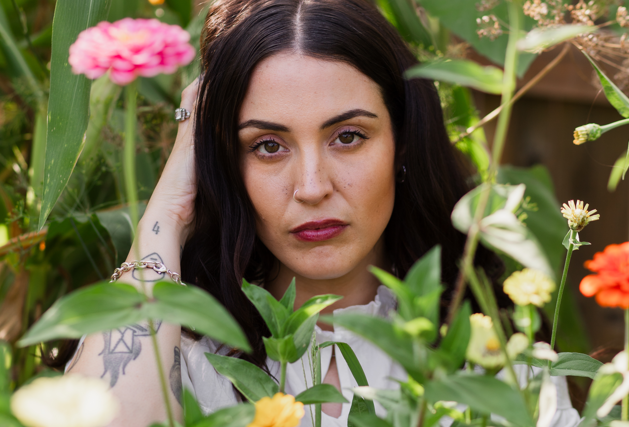

In Barcelona Evelí Ray gathers an international collection of musicians to produce art pop music, showing a strong preference for acoustic instruments and musical ideas from various traditions; this collaborative method was demonstrated on her first album, Butterflies. The new single “Tiempo”, which came out on September 30, carries on this approach with a notably interesting mix of Argentine cueca, electronic production, piano and saxophone, all of which are used in a song dealing with the limited amount of time we have to create and love.
The idea has a satisfying physical quality to it. A piece dealing with the subject of death could quite easily fill its whole duration by merely thinking about itself. By giving these thoughts a rhythm, Ray achieves something dynamic. Instead of using a conventional percussion instrument, he places the bombo legüero, which carries the cueca pattern, right at the heart of the modern recording. Time thus becomes both something that is reflected upon and something that is counted and performed. When facing such a major theme, this is a sensible starting point.
This combination also gives the song “Tiempo” a more defined identity than the general art-pop label implies. The use of piano, electronics, and an Argentine rhythmic base brings together various musical backgrounds. What interests me in this case is the connection between the concept and the instrumentation: a repeated rhythm going with a lyric that talks about cycles, as well as acoustic instruments being included in a recording that has been shaped electronically. There is enough for the listener to follow apart from the main philosophical question.
The saxophone solo is provided by Juan Martín Medina. Although his work as a touring musician with Julieta Venegas is a well-known aspect, the more interesting point is his role in this specific song. The solo allows the instrumentalist to formulate a response to the singer and to convey part of the emotional content through the use of breath and timing. Given that the song is concerned with the way we spend our lives, allowing space for another musician to have his own voice is itself significant.
The recording took place at Medusa Estudio in Barcelona and was mixed by Érico Moreira before being mastered in Brazil by Felipe Tichauer. This should be seen as a demonstration of the collaborative nature of the project, showing how Ray’s presence in Barcelona extends to multiple countries. The song still centres on a question so personal that it could follow anyone back to their home: what is worth the hours we have available?
Ray’s solution is to say that creation and love are the two things in question. In both cases, one dedicates time to something the result of which is uncertain, and this uncertainty gives the situation a pleasant human element. Even if you can measure a day exactly you may still find it difficult to decide how to spend it. The piece called “Tiempo” takes up that familiar kind of tension and sets it in a musical context by finding a link between the repeated beat of a dance rhythm and the much less orderly nature of being alive.
*This review was made possible by MusoSoup