
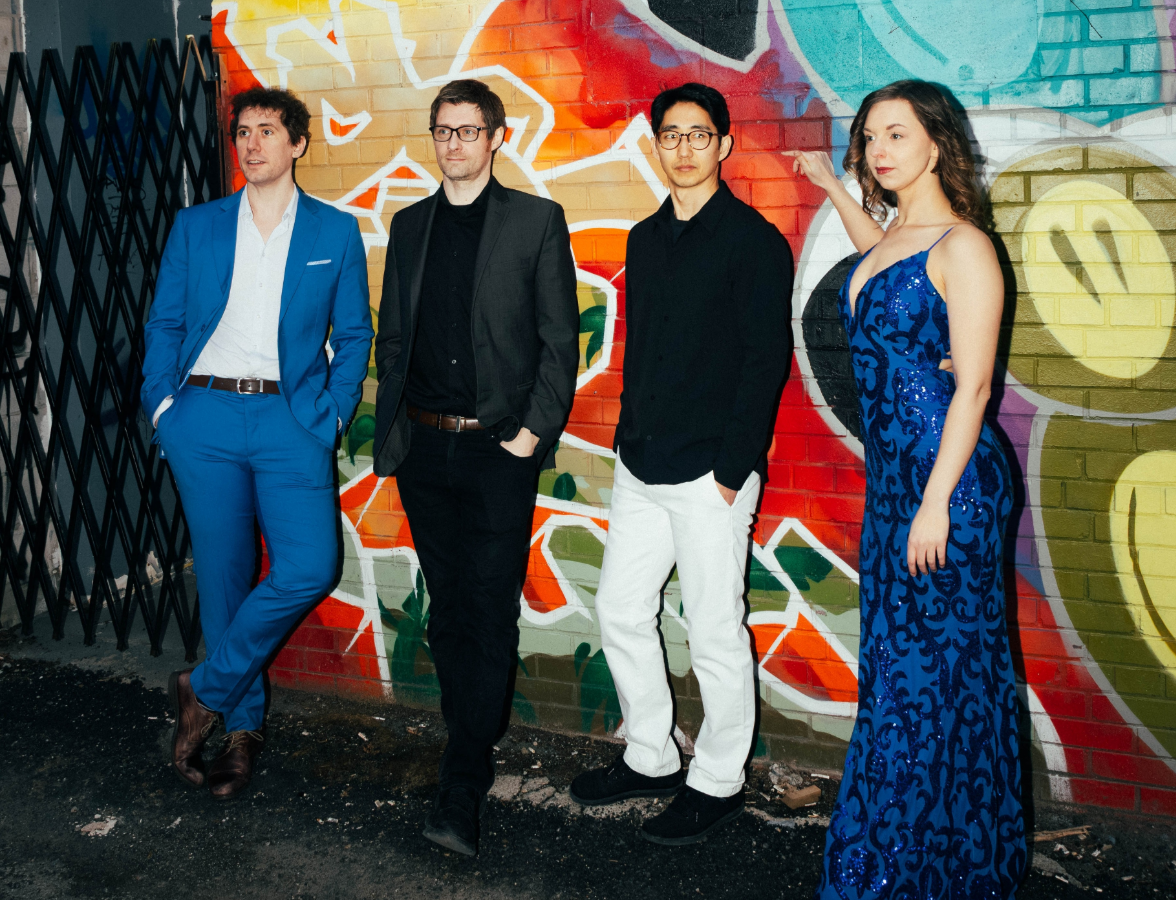
Awake & Dreaming have a frontperson who sings inward and a band that plays outward, and their debut album Inevitable spends ten songs testing how long those instincts can occupy the same room. Vocalist and keyboardist Sasha Kristoff often sounds most compelling at the point where privacy becomes difficult, with guitarist Stefan Schneider, bassist Phil Lee and drummer Ryan Dugal expanding around her in broad alt-rock gestures.
The Canadian quartet clearly has arenas in its peripheral vision, although sheer size provides only half of its appeal. The sharper moments arrive when Kristoff retains the tone of a private admission while the guitars demand a public response, even as the sequencing occasionally separates those two scales too neatly.
The sequence begins inside the gothic unease of I U Me and ends with Event Horizon, a closer whose prayer-like form exchanges confrontation for awe. Between them, distortion often behaves as pressure: guitars widen the frame, crowd the vocal and occasionally seem ready to erase the person at the centre. Kristoff keeps her phrasing measured, so the songs retain a human proportion even at their largest. The finale eventually brings piano confession and electric impact into the same calmer arrangement.
Rewire captures the quartet at its most convincing because the noisy guitar layer and Kristoff’s vocal appear to pursue different emotional goals. Schneider fills the surrounding space with agitation while her delivery remains clear and controlled, producing tension through placement rather than theatrical excess. I expected the voice to rise and conquer the arrangement once the pressure increased, a familiar piece of arena-rock engineering, yet the performance stays embedded in the noise and preserves its vulnerability. Jay Dufour’s mix keeps each part sharply legible, sometimes almost too sharply; the heaviest sections carry polish where a rougher guitar edge or a strained vocal take could have brought extra danger. Rewire survives that orderliness because its conflict remains audible throughout the track instead of resolving into a routine victory chorus.
The lead single Underwater approaches the same emotional territory through the album’s cleanest pop writing. A whale drifts beyond the reach of any answer while Kristoff’s open vocal melody carries a distant echo of The Cranberries, placing an enormous image inside a direct and accessible arrangement. Her delivery carries the sleepless repetition of two-in-the-morning self-talk, and the chorus opens wider than the surrounding material. Its immediate appeal makes sense for a lead single, although my preference sits with Rewire, whose guitars place greater pressure on the voice and reveal a more distinctive version of the band.
The boldest sequencing decision comes later, when Lights Down Low and Can’t Sleep place two near-acoustic songs beside one another. Their reduced weight initially offers welcome relief after the louder passages, bringing Kristoff closer and allowing the piano-led side of the group to occupy the foreground. Across consecutive tracks, however, that relief settles into a plateau. Similar levels of intensity soften the border between the songs, and the album briefly suspends its internal argument. My attention slipped in roughly the same place across two listens, which says plenty about their placement. Either song could provide an effective solitary pause elsewhere in the running order; together they concentrate the quieter material into a separate block. Faceless returns with brighter momentum and a livelier attack, revealing how much the record had slowed and costing both acoustic songs some individual definition.
The album sounds most human when its opposing impulses overlap rather than taking turns. Kristoff singing through the guitar pressure in Rewire carries greater uncertainty than a quiet confession placed safely between subdued arrangements, while the propulsive entrance of Faceless gains character from the fatigue immediately behind it. The band’s synchronized live lighting also has an audible counterpart in the precise changes of intensity, with each expansion arranged almost as a visual cue. Occasionally the architecture becomes visible several bars early, especially when a restrained section begins preparing another large release, though the group usually places an affecting vocal or guitar detail inside the expected movement.
By the time Event Horizon arrives, the album has already used distortion for anger, pressure and catharsis, leaving the finale to seek another language. Its prayer-like character avoids an arena-sized victory lap and allows the promised sense of possibility to emerge through concentration. Kristoff’s voice sits level with the band here, while the arrangement finally joins intimacy and scale within the same performance. The ending altered my response to the controlled heaviness of the early songs and the long quiet patch later on. Inevitable carries a few crescendos whose destinations appear too soon, and its acoustic pairing would benefit from greater separation, yet the closing track changes the emotional role of everything before it. Scheduled for October 16 with a vinyl pressing. After the finale, I U Me carried more apprehension than gothic spectacle, while Rewire remained the moment where Awake & Dreaming sounded closest to the band they could become.
*This review was made possible by SubmitHub